

The Nation That Inspired Nations
Sabbath 250

In August 1776, Benjamin Franklin, John Adams and Thomas Jefferson met in Philadelphia to create a seal for the United States. Today the familiar seal is the shield-clad eagle clutching both olives and arrows; but Franklin and Jefferson, though not particularly religious, originally sought a more Biblical inspired seal. Franklin thought that the seal should depict the ancient Egyptians drowning in the Red Sea, while Moses stood atop, arms uplifted, with a pillar of fire emanating rays of light. He suggested the words “rebellion to tyrants is obedience to God.” Jefferson thought instead that the seal should show a different desert scene: the Jewish people traveling to the Promised Land accompanied by the cloud of safety and pillar of protection. While neither seal was approved by the Congress—it would take another six years to approve the seal we know today—Jefferson adopted Franklin’s phrase, “rebellion to tyrants is obedience to God,” for his personal seal.
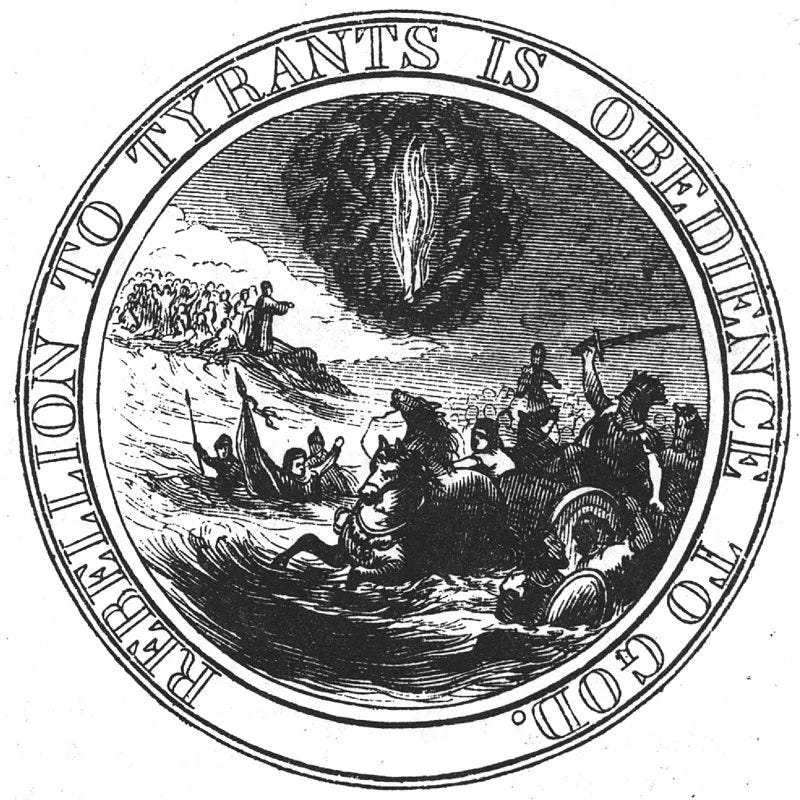
What this small episode signified was not only the enduring relevance of Jewish history, but its role as inspiration. For that reason, the choice inscription on the Liberty Bell which sits in Philadelphia today was a Biblical verse from Leviticus, “Proclaim Liberty throughout the land.” The coat of arms of Yale University, approved in 1722, is emblazoned with the Hebrew words “Urim V’Tumim;” and its seventh president, the aptly named Ezra Stiles, corresponded with Haim Isaac Carigal, a Rabbi living in Chevron, in order to study the Bible in its original language as intended. In 1777 Stiles instituted a mandatory Hebrew course for the students of Yale. He referred to the United States as “God’s American Israel.” It was John Quincy Adams, the son of John Adams, who saw the Jewish people as “messengers, specifically commissioned by [God], to warn the People of their duty.” Thomas Paine’s Common Sense, seen by many as the motivating spark for American independence from England, is mostly comprised of Biblical exegesis on the story of Shmuel, the prophet who warned the Jewish people against the election of a king.
And indeed, the early Americans weren’t the only group who looked towards the story of the Jews for inspiration. The Protestants led by Oliver Cromwell likened themselves to a covenantal and providential people; just as the Hebrews had unshackled themselves from oppression, so too would the English Protestants. The Scottish Presbyterians, the Dutch Revolt against the Spanish Catholics, Irish Catholics, the American abolitionists, and later Civil Rights leaders like Martin Luther King Jr. all found inspiration in the idea of a people led by God towards a promised land. In the words of the latter, in a speech given in 1965 to Temple Israel of Hollywood, “In some real sense, we are all moving toward some ‘promised land’ of personal and collective fulfillment. In every age and every generation, men have envisioned a promised land. Some may have envisioned it with the wrong ideology, with the wrong philosophical presupposition. But men in every generation thought in terms of some promised land.”
All of this is to say that we shall never take for granted that which is ours. On the cusp of Shavuot, we read the story of Jewish encampment around the Mishkan. What both represent is God’s continued relation to the people and the intention of that relationship. On Shavuot God convened the people for a covenant, reinforcing the idea that freedom comes with a purpose and obligation. The expression of that mission culminates in Bamidbar. That nomadic life which seemed to be marked by endless wandering in the desert was truly anchored in a divine mission and purpose: a journey, together with God, to the promised land. We remain committed to that same mission and purpose today, centering the Mishkan—the embodiment of holiness and sanctity—yet still. That legacy is precisely what inspired the greatest, most peaceful and most prosperous movements in world history.
Are we to be chauvinistic? Never. The goal is to remember that at a time when the world seeks to continually libel us for imagined evils, we never lose sight of the fact that beyond the daily news cycle of the New York Timesstands our tremendous and everlasting tradition and legacy.
In response to the French writer, Voltaire, an avowed antisemite, John Adams wrote, “How is it possible [that you] should represent the Hebrews in such a contemptible light? They are the most glorious nation that ever inhabited this Earth. The Romans and their Empire were but a Bauble in comparison of the Jews. They have given religion to three quarters of the Globe and have influenced the affairs of Mankind more, and more happily, than any other Nation ancient or modern.” May we recall such teachings.